Many people with Parkinson's disease live comfortably on medication alone for years, and surgery is neither the first step in treatment nor something every patient will need. Over time, though, some patients reach a stage where medication no longer controls tremor, stiffness, or slowness of movement throughout the day. That is exactly the point at which the surgical option deserves a proper assessment rather than being put off for years.
What Is Parkinson's Disease, and Why Do Some Patients Need Surgery?
Parkinson's disease affects cells deep in the brain that produce dopamine, the chemical that regulates movement. As dopamine drops, patients develop tremor, muscle stiffness, slowness of movement, and problems with balance. Medication replaces what is missing, which is why it works so well in the early years — the period doctors sometimes call the medication "honeymoon."
But the disease continues to progress, and the brain gradually loses its ability to store and use the medication steadily. Patients start to feel their symptoms return between doses, or begin to experience side effects from the medication itself. Surgery does not cure the disease or stop it from progressing, but it acts directly on the overactive circuits inside the brain, easing symptoms significantly and giving patients back a great deal of stability in their day.
What Are the Signs That Medication Is No Longer Enough?
The clearest sign is that the medication's effect now comes and goes through the day instead of holding steady. Watch for these in particular:
- Tremor or stiffness returning noticeably before the next dose is due.
- Repeatedly needing higher doses, or doses closer together, to get the same benefit as before.
- Extra involuntary movements of the limbs or trunk after taking medication — a well-known side effect of long-term treatment.
- Tremor that stays visible and troublesome even at the maximum tolerated dose.
- Difficulty with simple daily tasks such as eating, writing, holding a cup, or buttoning a shirt.
- Stiffness that makes rising from a chair or starting to walk a real effort.
Having one or more of these signs does not mean surgery is already decided. It does mean it is time for a specialist assessment, rather than adjusting the dose one more time and waiting.
When Should You See a Doctor Urgently?
See your doctor without delay if any of the following happen:
- Repeated falls or sudden loss of balance, because of the risk of fractures and head injury.
- Sudden difficulty swallowing, or repeated choking while eating or drinking.
- Rapid, unusual deterioration in movement over a few days or weeks.
- Confusion, visual hallucinations, or a clear change in behaviour after a medication change.
- Sudden freezing of the feet while walking that leaves you stuck and at risk of falling.
These need urgent evaluation before any surgical discussion, because some of them have another treatable cause or call for an immediate change in medication.
Can Symptoms Be Controlled Without Surgery?
Yes — and for most patients this is the right path for years. Treatment starts with carefully adjusted medication, with doses and timing tailored to how each patient responds, supported by physiotherapy and balance and gait exercises that maintain muscle strength and reduce the risk of falls.
Speech and swallowing therapy helps when needed, as does timing meals sensibly around medication doses. Sleep and mental health are also worth monitoring closely, since both have a direct effect on how severe symptoms feel. Surgery is raised only once these options have been used properly and the patient remains unstable despite them.
When Does Surgery Become Necessary?
Surgery becomes a serious option when the response to medication keeps fluctuating despite the treatment being optimised as far as it can be. In practice, the surgical option is discussed when:
- Medications help, but the benefit comes and goes through the day in a way that affects daily life.
- Tremor remains difficult to control despite full medical treatment.
- Stiffness and slowness of movement persist at maximum tolerated medication doses.
- Involuntary movements appear as a medication side effect that dose adjustment cannot resolve.
It is important to understand that surgery does not replace medication for everyone, but for the right patient it can dramatically reduce symptoms and lower the daily medication burden. You can read more about the procedures available on the Parkinson's disease surgery page.
Who Is a Suitable Candidate for Surgery?
A suitable candidate is someone whose symptoms clearly affect daily life but who still shows a definite response to medication, even if only for part of the day — that response is itself an important indicator that surgery is likely to help. General health, including heart and lung fitness for anaesthesia and surgery, also has to be adequate.
On the other hand, surgery may not be appropriate for someone with significant decline in memory and thinking, unstable psychiatric illness, or general medical problems that make the procedure high-risk. This is why the decision is never made on imaging alone, nor on symptom severity alone. It comes from a full assessment: detailed neurological examination, evaluation of the response to medication, brain MRI, cognitive and psychological assessment, and a frank discussion with the patient and family about what surgery can and cannot achieve.
What Surgical Options Are Available?
There are two main procedures, chosen according to each patient's situation:
Radiofrequency ablation. A targeted, precise treatment of the overactive brain circuit deep in the brain that is responsible for tremor. It is performed in carefully selected patients and can be a strong option where deep brain stimulation is not suitable, whether for medical reasons or because of the follow-up a device requires.
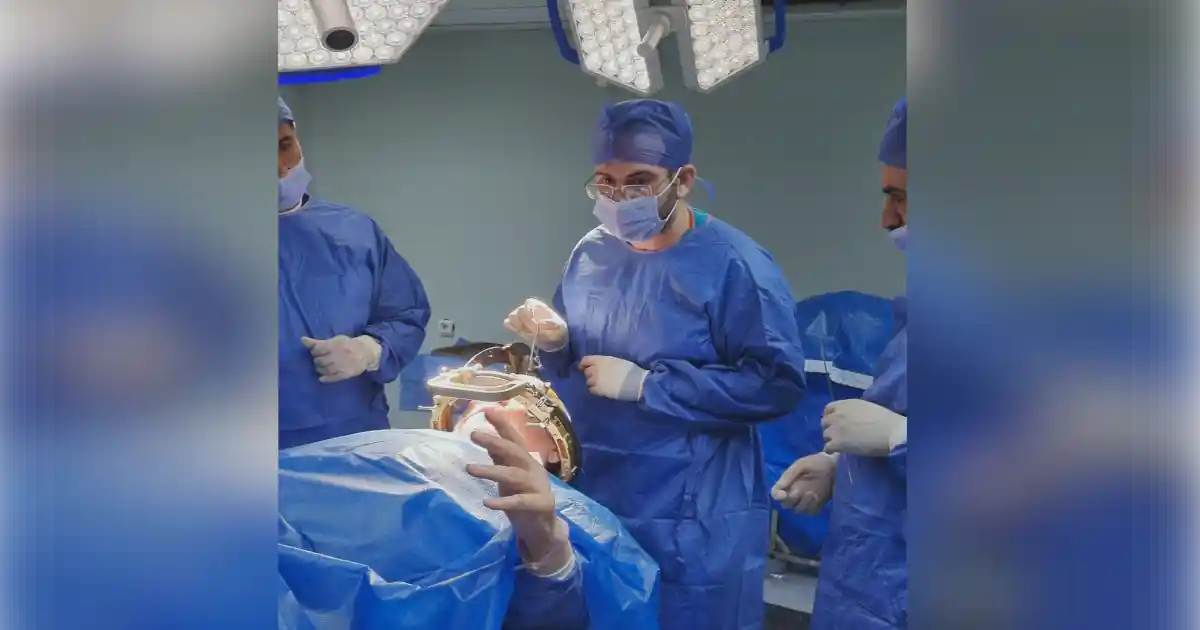
Deep brain stimulation (DBS). A fine electrode is placed in the movement-control area of the brain and connected to a small pacemaker-like device. Its main advantage is that the stimulation is adjustable, and settings are fine-tuned to each patient over time as their condition changes.
Both procedures depend on locating the target inside the brain with very high accuracy, before and during surgery, which makes careful planning and experience in movement-disorder surgery decisive for the result.
How Long Does Recovery Take?
The hospital stay is usually short — a matter of a few days — and many patients notice an improvement in tremor early after surgery.
After discharge, patients return to normal daily activity gradually over several weeks, with regular follow-up so medication doses can be adjusted as symptoms improve. For deep brain stimulation, additional sessions are needed over the first months to programme and fine-tune the device settings until the best possible result is reached. Continuing physiotherapy and balance exercises after surgery remains an essential part of recovery, not an optional extra.
Book an Appointment
If you or a family member is dealing with medication that wears off or tremor that no longer responds to treatment, you can read more about Parkinson's disease surgery and the story of a patient who regained steady hands to see what the treatment journey looks like. Then book a consultation with Dr. Mazen Agour through the contact page — and bring your current medication list and any recent brain imaging with you.