When Parkinson's medication starts to wear off too quickly, causes troubling side effects, or no longer controls tremor, muscle stiffness, and slowness of movement, surgery can give many patients years of better movement and a steadier daily life.
When surgery is considered
Surgery is usually discussed when:
- Medications help, but the benefit comes and goes through the day.
- Tremor remains difficult to control despite treatment.
- Muscle stiffness and slow of Movement with maximum doses of medication.
- Involuntary movements (dyskinesia) appear as a side effect of medication.
Surgery does not replace medication for everyone, but for the right patient it can dramatically reduce symptoms and lower the daily medication burden.
The two procedures offered
Radiofrequency Ablation. A targeted, precise treatment of the overactive brain circuit responsible for tremor. It is performed in carefully selected patients and can be a strong option where DBS is not suitable.
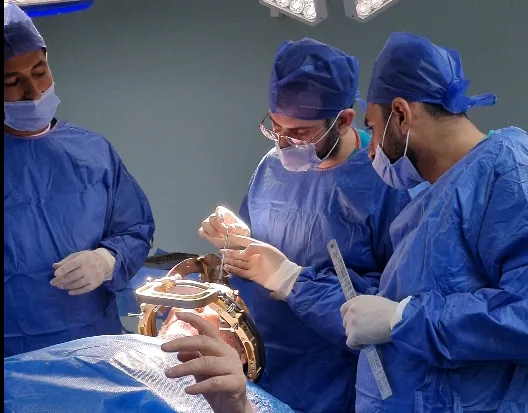
Deep Brain Stimulation (DBS). A fine electrode is placed precisely in the movement-control area of the brain and connected to a small pacemaker-like device. The stimulation is adjustable and reversible, and settings are fine-tuned to each patient over time.
Why Dr. Mazen Agour
Dr. Agour's PhD research focused on movement disorders — specifically the role of ablation in Parkinson's disease. He further trained in epilepsy and movement-disorder surgery during his fellowship at the Amrita Institute in India and during observership in France. Each case is assessed individually to choose the safest, most effective approach.
Book a consultation
Bring your current medication list and any recent brain imaging to your visit. You can reach the clinic directly on WhatsApp to arrange an appointment.